
This transcript was machine-generated and may contain spelling errors or other inaccuracies.
Leer en Español
Lawanda Horton: Roosevelt Boulevard en Northeast Philly es una de las granjas enteras más concurridas. También es una de las carreteras más peligrosas de la ciudad. Según el Departamento de Transporte de Pennsylvania, Más de una de cada 10 muertes por accidentes de tráfico ocurren en Filadelfia Boulevard.
Block by Block reportero Chelsea Lubbe se reunió con el Dr. J. Arzu en 30th Street Station para hablar sobre una forma de hacer el camino mucho más seguro.
Jay Arzu: ¿Qué es Roosevelt Boulevard? Es un monstruo. Se ha quitado la vida de mucha gente. Sé que algunas personas son como, oh, por qué estás tratando de ¿Personificar un camino? Bueno, la forma en que Roosevelt Boulevard era antes de 1955 Muy diferente.
Fue más parecido a la autopista Benjamin Franklin. Eran puentes ornamentales que eran hermosos y cuidadosos. Era un lugar muy bonito. Pero en última instancia, cuando hicieron la expansión de ella a los 12 carriles que existen hoy, Lo hicieron muy inseguro.
Así que mi esperanza es que podamos convertir el Boulevard de la Muerte en el Boulevard de la Vida. Y la forma de hacerlo es rehacer la vía por completo y convirtiéndolo en peatonal primero, pero también teniendo el metro Boulevard finalmente conectados a estas comunidades para que podamos ser una Filadelfia.
Chelsea Lubbe: Funcionarios de Filadelfia han estado hablando de construir un metro de Roosevelt Bouvard para más de 100 años. Y cuando J.R. Zu se mudó de Nueva York a Filadelfia para obtener un doctorado en de la ciudad y planificación regional, decidió completar una disertación en el tema.
Abogar por un transporte público accesible es una pasión que nace de su propia urgencia para construir una ciudad más fuerte y más conexiones a través de los Philadelphians. A lo largo de su investigación, ha visto similitudes con Nueva York.
Su ciudad comenzó finalmente la construcción de una segunda avenida metro recientemente después Casi 100 años de planificación. Pero Arzu dice que el progreso en Filadelfia ha sido aún más lento.
Jay Arzu: Encontré que Filadelfia tenía su propia versión de eso, el Roosevelt Boulevard metro, y en realidad habían construido una estación para él A finales de la década de 1960, Estación Adams. Finalmente fue demolido en 1994.
pero el hecho de que habían construido la estación, anticipó que sucediera, había construido viviendas destinadas a comunidades transitadas o comunidades dependientes del tránsito, y el metro nunca llegó, ya sabes, fue una tragedia para Yo.
Así que quería aprender más sobre eso.
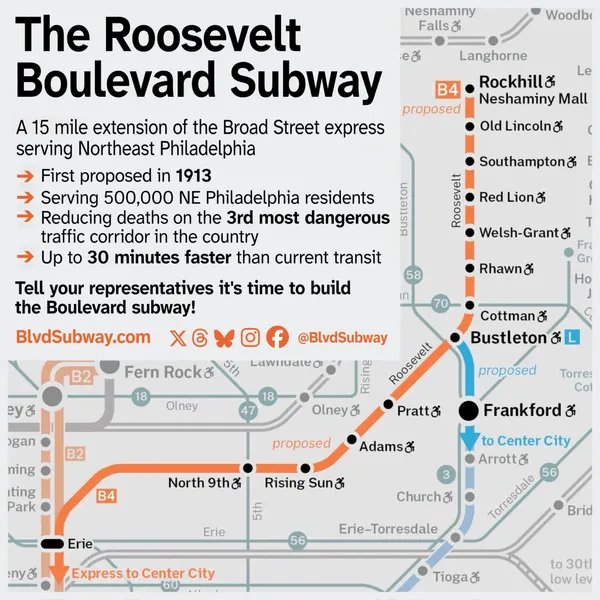
Chelsea Lubbe: Los planes para el bulevar Roosevelt incluirían una extensión de 14 millas del Línea de calle ancha. Eso se integraría con una extensión de unmil de la línea Market-Frankfurt en Busselton Station. A pesar del trabajo inicial en la década de 1960, Arzu dice que no ha sido mucho progreso para construir un metro operativo dentro de los límites del El bulevar de Roosevelt.
Jay Arzu: Si vienes del noreste, estás hablando de una hora de viaje o más veces, y eso es Eso no es propicio para el crecimiento económico. Eso no es propicio para tener una cohesión de la comunidad.
Chelsea Lubbe: Después de que Arzu escribió un artículo para el Philadelphia Inquirer hace cuatro años, mirando la viabilidad del proyecto y lo que significaría para la comunidad, el Representante Estatal Jared Solomon se acercó a Arzu organizar un ayuntamiento para ver lo que los miembros de la comunidad pensaban.
Jay Arzu: Las personas no solo se presentaron al frente Primer ayuntamiento, lanzamos dos más y teníamos la misma cantidad de números. Personas que fueron como, ¿Qué podemos hacer para mover esto? ¿Proyecto a seguir? En el segundo ayuntamiento, la gente venía a poner la presión en el Departamento de Transporte de Pensilvania para iniciar un estudio de factibilidad el metro.
Querían hablar sobre cómo se ven afectados por la falta de La conexión. Entre el noreste y el resto de la ciudad, porque uno de cada tres Los habitantes de Filadelfia viven en el noreste, son 500.000 personas.
Chelsea Lubbe: Con muchos residentes del noreste emocionados por el proyecto, Arzu dice que El Departamento de Transporte de Pensilvania acordó agregar el metro a su Ruta programa de planificación de seguridad para el bulevar, que se ha estado en marcha por más de una década.
Finalmente, PennDOT propuso una serie de opciones que incluyen un rápido tránsito en autobús sistema, un sistema de tren ligero o el metro. Arzu dice que hasta 62.000 personas viajarían en estos sistemas cada El día.
Jay Arzu: Y aunque respetamos estos pasos incrementales, continuaremos empujando para que este proyecto se mueva más rápido porque nuestro Las ciudades de muelle, no están esperando 10, 15 años para empujar su proyectos. Les están preparando la pala para que cuando haya una administración que está un poco más abierto a financiar proyectos En general, están listos.
Chelsea Lubbe: Pero Arzu dice que los legisladores de Pensilvania en Harrisburg son reacios a aprobar financiación para proyectos de transporte público en Filadelfia.
Jay Arzu: El Partido Republicano del Senado de Pensilvania básicamente poniendo excusa después de la excusa por qué no deberíamos financiar SEPTA y continuar moviendo el poste de meta porque la realidad es que tienen muy poco interés en financiar el transporte público y este La región ayuda a alimentar el estado.
Nuestros dólares de los contribuyentes van a Harrisburg y básicamente están diciendo Para nosotros, bueno, ya sabes, no queremos financiar el cosa que mueve tu región, lo cual es, en cierto sentido, perjudicando Toda la Mancomunidad de Pennsylvania.
Chelsea Lubbe: Arzu entiende que construir un nuevo metro es una tarea grande y cara, pero dice que el actual jefe de SEPTA, Scott Sauer, ha demostrado que una inversión en esta forma de transporte público puede ahorrar dinero.
y apoya a los residentes.
Jay Arzu: La ciudad de Filadelfia no ha construido algo tan grande desde el Centro City Commuter Tunnel a finales de los años 70 y principios de los 80. Así que es un desafío, pero de lo que está hecha la vida.
Scott Sauer ha sido capaz de hacer un trabajo increíble mostrando que el sistema puede funcionar, y fue capaz de ahorrar más 30 euros millones de este pasado. Año. Han sido capaces de demostrar que el sistema pudo hacer con huesos desnudos.
Imagínese lo que podríamos hacer con la financiación estatal adecuada. Si permitieras a los Philadelphians tomar esa decisión por sí mismos, Ir a las urnas y decir, queremos un sector mejor. Queremos un sistema de clase mundial del que la gente pueda estar orgullosa.
Nuestra región merece algo mejor. Se trata de Construyendo un futuro mejor para los habitantes de Filadelfia y las generaciones futuras que nunca Sabemos quiénes somos y esperamos que hagan lo mismo.
Chelsea Lubbe: Puedes encontrar más sobre el Metro de Roosevelt Boulevard y Dr. La investigación de Jay Arzu visitando BoulevardSubway.com. Para el bloque, soy Chelsea Lubbe.
Lawanda Horton: Roosevelt Boulevard in Northeast Philly is one of the city's busiest thoroughfarefares. It's also one of the most dangerous roads in the city. According to the Pennsylvania Department of Transportation, More than one in 10 traffic deaths in Philadelphia happen on the Boulevard.
Block by Block reporter Chelsea Lubbe met with Dr. J. Arzu at 30th Street Station to talk about one way to make the road much safer.
Jay Arzu: What is Roosevelt Boulevard? It's a monster. It's taken the lives of a lot of people. I know some people are like, oh, why are you trying to personify a road? Well, the way that Roosevelt Boulevard was before 1955, it was a lot different.
It was more akin to the Benjamin Franklin Parkway. They were ornamental bridges that were beautiful and manicured. It was a very beautiful place. But ultimately, when they did the expansion of it to the 12 lanes that exist today, They made it very unsafe.
So my hope is that we can turn the Boulevard of Death into the Boulevard of Life. And the way to do that is remaking the thoroughfare completely and making it pedestrian first, but also having the Boulevard subway finally be connected to these communities so we can be one Philadelphia.
Chelsea Lubbe: Philadelphia officials have been talking about building a Roosevelt Bouvard subway for more than 100 years. And when J.R. Zu moved from New York to Philadelphia to get a PhD in city and regional planning, he decided to complete a dissertation on the subject.
Advocating for accessible public transit is a passion born from his own urgency to build a stronger city and more connections across Philadelphians. Throughout his research, he has seen similarities to New York. His hometown finally started construction of a second avenue subway recently after nearly 100 years of planning.
But Arzu says progress in Philly has been even slower.
Jay Arzu: I found that Philadelphia had their own version of that, the Roosevelt Boulevard subway, and they actually had built one station for it in the late 1960s, Adams Station. It was ultimately demolished in 1994.
but the fact that they had built the station, anticipated it happening, had built housing that was meant for transit-oriented communities or transit-dependent communities, and the subway never came, you know, was such a tragedy to me.
So I wanted to learn more about it.
Chelsea Lubbe: Plans for the Roosevelt Boulevard would include a 14-mile extension of the Broad Street line. That would integrate with a one-mile extension of the Market-Frankfurt line converging at Busselton Station. Despite the initial work in the 1960s, Arzu says there has not been much progress to build an operating subway within the boundaries of the Roosevelt Boulevard.
Jay Arzu: If you're coming from far northeast, you're talking about an hour ride or more sometimes, and that's That's not conducive to economic growth. That's not conducive to having a cohesion of the community.
Chelsea Lubbe: After Arzu wrote an op-ed for the Philadelphia Inquirer four years ago, looking at the feasibility of the project and what it would mean for the community, State Representative Jared Solomon reached out to Arzu to organize a town hall to see what community members thought.
Jay Arzu: People not only showed up to the front First town hall, we threw, we threw two more and we had the same amount of numbers. Folks who were just like, What can we do to move this project forward?
In the second town hall, people were coming to put the pressure on the Pennsylvania Department of Transportation to launch a feasibility study for the subway. They wanted to talk about how they're affected by the lack of connection.
Between Northeast and the rest of the city, because one in three Philadelphians lives in Northeast, it's 500,000 people.
Chelsea Lubbe: With many Northeast residents excited about the project, Arzu says that the Pennsylvania Department of Transportation agreed to add the subway into its Route for Change safety planning program for the boulevard, which has been underway for more than a decade.
Eventually, PennDOT proposed a series of options that include a rapid bus transit system, a light rail system, or the subway. Arzu says as many as 62,000 people would ride these systems every day.
Jay Arzu: And while we respect these incremental steps, we will continue to push for this project to move faster because our Pier cities, they're not waiting for 10, 15 years to push their projects. They're getting them shovel ready so that when there is an administration that's a little bit more open to funding projects that are this big, they're ready.
Chelsea Lubbe: But Arzu says Pennsylvania lawmakers in Harrisburg are reluctant to approve any funding at all for public transit projects in Philly.
Jay Arzu: Pennsylvania Senate GOP basically making excuse after excuse why we shouldn't fund SEPTA and continuing to move the goalpost down because the reality is that they have very little interest in funding public transportation and this region helps power the state.
Our taxpayer dollars are going to Harrisburg and they're basically saying To us, hey, well, you know, we don't want to fund the thing that moves your region, which is, in a sense, hurting the entire Commonwealth of Pennsylvania.
Chelsea Lubbe: Arzu understands that building a new subway is a big, expensive undertaking, but he says the current head of SEPTA, Scott Sauer, has shown that an investment into this form of public transportation can save money.
And support residents.
Jay Arzu: The city of Philadelphia hasn't built something this big since the Center City Commuter Tunnel in the late 70s and early 80s. So it is a challenge, but that's what life is made of. Scott Sauer has been able to do an amazing job showing that the system can work, and he was able to save over $30 million over this past.
Year. They've been able to show that the system was able to do it with bare bones. Just imagine what we could do with proper state funding. If you allowed Philadelphians to make that choice for themselves, they would go to the ballot box and say, we want a better sector.
We want a world-class system that people can be proud of. Our region deserves better. It's about Building a better future for Philadelphians and future generations that will never know who we are and hopes that they'll do the same.
Chelsea Lubbe: You can find out more about the Roosevelt Boulevard Subway and Dr. Jay Arzu's research by visiting BoulevardSubway.com. For block by block, I'm Chelsea Lubbe.
This story was broadcast as part of November 11, 2026 (Block by Block).